 Share on Facebook
 Share on LinkedIn
 Share on Twitter

AcuPower Blog | AcuPower ERP Team
Every ERP release tells a story. Acumatica’s 2026 R1 tells a particularly clear one about where cloud ERP is heading. Here’s what we think it tells us and what it means for companies evaluating their options right now.
If you only read Acumatica’s release notes for 26R1, you’d see a long list of features: a Shop Floor Kiosk, AI Studio enhancements, batch pick shortage alerts, an unbilled revenue ageing report. Useful, certainly. But what makes this release worth writing about is the pattern underneath those features.
At AcuPower, we’ve been implementing Acumatica for years and tracking the platform’s evolution closely. 26R1 isn’t just a feature update. It represents three shifts that every company evaluating ERP in 2026 should understand.
Shift 1: ERP is moving to the point of work
For decades, ERP has been a back-office system. Data was generated on the shop floor, in the warehouse, or on a job site, and then someone walked to a computer and typed it in. Sometimes hours later. Sometimes the next day. The result was a system that always ran slightly behind reality.
26R1 marks a deliberate move away from that model. The new Shop Floor Kiosk gives production workers a simplified interface to capture data directly as work happens. Seconds-level time tracking adds a layer of precision that wasn’t previously available, giving manufacturers a more accurate picture of labour costs across thousands of operations. Mobile card readers let field teams process payments on site, reducing the manual paperwork that typically follows.
The pattern is consistent: Acumatica is designing for the person doing the work, not just the person reporting on it. That’s a significant philosophical shift, and one we’re seeing across the cloud ERP market more broadly. The systems that win in 2026 and beyond are likely to be the ones that meet users where they already are, whether that’s a factory floor, a warehouse aisle or a construction site.
For companies still evaluating ERP, this is worth testing in every demo you sit through. Ask where the data entry happens. If the answer is still ‘a desktop screen in the office,’ you’re looking at a system designed for the last decade, not this one.
Shift 2: AI is becoming operational, not experimental
Every ERP vendor is talking about AI in 2026. But there’s a meaningful difference between AI as a marketing message and AI as something your operations team can actually use.
Acumatica isn’t the only vendor building AI into its platform, but the progression across its last three releases is worth examining. In 25R1, they introduced AI-powered cost anomaly detection for manufacturing. In 25R2, they launched AI Studio, a no-code tool that lets companies build AI workflows without managing an LLM. In 26R1, they’ve added early access to an AI Assistant that gives users a conversational way to surface insights from their own data, alongside data masking controls that let regulated industries govern which data AI can access.
That three-release arc tells you something important. This isn’t a vendor bolting AI onto an existing product for a press release. It’s a cumulative build: detection first, then workflow automation, then conversational intelligence, with data governance woven in at each stage.
At Acumatica Summit 2026, one of the clearest signals from the customer base was the demand for AI that works without requiring companies to build or manage their own models. That’s what the no-code AI Studio approach delivers, and it’s why mid-market companies are responding to it differently from the way they responded to earlier generations of ‘intelligent ERP’ that required data science teams to operationalise.
For companies evaluating ERP, that trajectory matters more than any single feature. You’re not just buying what AI does today; you’re buying the vendor’s approach to what AI will do in two years. We’d encourage any company in an evaluation process to ask their shortlisted vendors one simple question: show me what your AI strategy looked like three releases ago, and tell me where it’s going three releases from now. The answer will tell you whether you’re looking at a roadmap or a reaction.
Of course, your vendor’s AI roadmap is only half the picture. The other half is whether your own business is ready to take advantage of it. If your data isn’t centralised, your workflows aren’t documented, or your team hasn’t started thinking about what AI could automate, even the most capable platform won’t deliver results on day one.
Assess your starting point: We’ve put together an AI Readiness Evaluation Checklist that walks you through five key areas: data integration, automation, user adoption, scalability, and security. It takes five minutes and gives you a clear picture of where you stand before you start evaluating platforms.
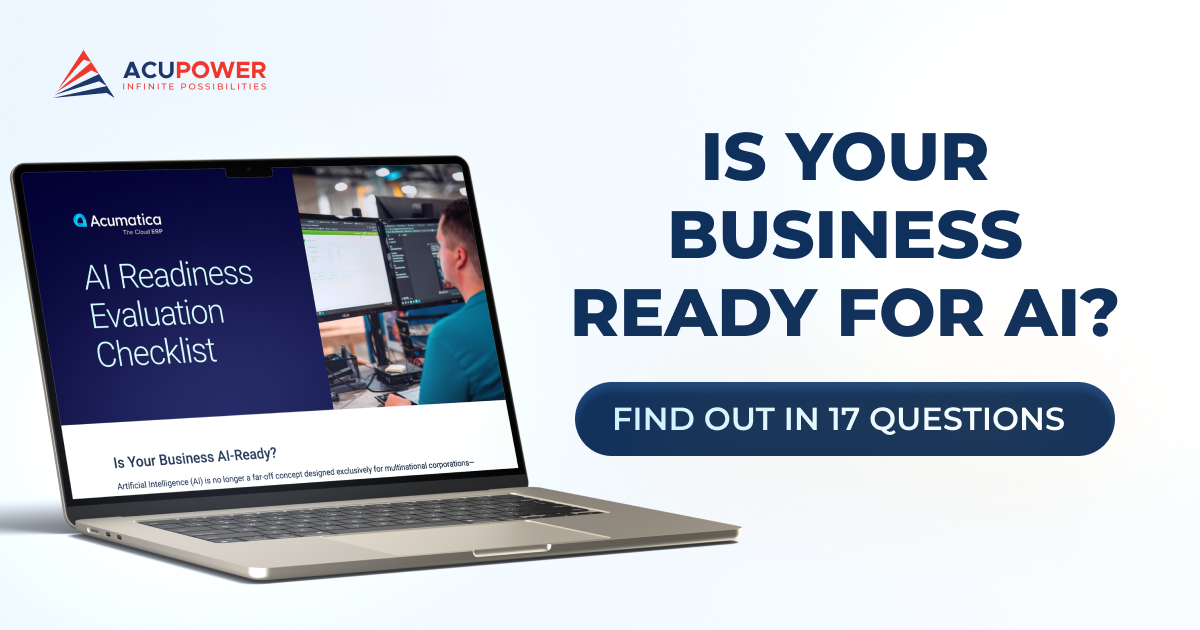
Download the AI Readiness Checklist
Shift 3: Operations-first, not finance-first
Here’s something that caught our attention: when Acumatica announced 26R1, one of its press releases led with supply chain management. Not finance. Not reporting. Supply chain.
That’s unusual. ERP vendors have historically led with financial consolidation, compliance, and reporting because that’s where the buying decision traditionally sits. The fact that Acumatica chose to headline with warehouse automation, batch pick shortage handling and smarter putaway recommendations signals something broader: while finance remains central to any ERP decision, buyers increasingly expect the system to cover the full operational cycle as well.
This aligns with what we see across our client base at AcuPower. The companies choosing Acumatica today aren’t just looking for better financial reporting. They’re looking for a system that can handle manufacturing, warehousing, distribution, field service and project management — all connected, all in real time. The financial layer matters, of course, and it’s still where the CFO’s attention sits. But it’s no longer the only starting point for the conversation.
Features like the new project audit trail in 26R1 reinforce this point. It gives construction and professional services firms traceability over changes to project records, covering the kind of modifications that matter for contract disputes, lender reporting, and regulatory audits. That’s not a finance feature. It’s a risk management tool and an operational safeguard, built into the same system that handles your billing and your field operations.
For mid-market companies still running legacy systems, this shift is worth paying attention to. If your current ERP handles your books well but struggles with warehouse visibility, production tracking, or field operations, you’re not just behind on features. You’re behind on the direction the entire category is moving. And the gap is widening with every release cycle.
What does this mean if you’re evaluating ERP now?
We’re not suggesting that one release from one vendor defines the future of enterprise software. But 26R1 is a clear data point in a larger trend. Cloud ERP is evolving from a system of record into a system of action: real-time data capture at the point of work, AI that operates inside your workflows rather than alongside them and a design philosophy that treats operations and finance as equally important.
If you’re in the middle of an ERP evaluation, use this framework to pressure-test every vendor on your shortlist. Ask where data gets captured and by whom. Ask what their AI can do today versus what’s on a roadmap slide. Ask whether the system was designed around financial reporting first or whether it treats operational execution as a first-class capability. The answers will separate the platforms built for where business is going from the ones still optimised for where it’s been.
At AcuPower, we help mid-market manufacturers, distributors, and project-driven businesses implement Acumatica. If you’d like to see how these 26R1 capabilities work in practice, or if you want an honest conversation about whether Acumatica is the right fit for your business, let’s talk.
Talk to us about whether 26R1 changes your evaluation
About the author: AcuPower is an Acumatica Gold Certified Partner specialising in ERP implementations for manufacturing, distribution, and project-driven industries.
Comments (0)
No comments yet
Be the first to comment


 39
39