 Share on Facebook
 Share on LinkedIn
 Share on Twitter

AcuPower Blog | AcuPower
5 min read
Most UK metal and advanced engineering businesses can’t answer that quickly, and it’s not really an ERP question. It’s about proving where every part came from and seeing what’s happening on your shop floor right now.
Ask most metal fabrication or precision engineering businesses how a job is going, and you’ll get an honest answer: “Let me check.” Someone walks the floor. Someone calls a supervisor. Someone opens two or three spreadsheets that don’t quite agree with each other.
That’s not a people problem. It’s a data problem, and it’s an old one. Most shops didn’t design their processes around real-time information. They grew up on paper travellers, whiteboards and spreadsheets, and those tools worked fine when the business was smaller and the stakes were lower.
They don’t work as well now.
What “traceability” and “real-time visibility” actually mean
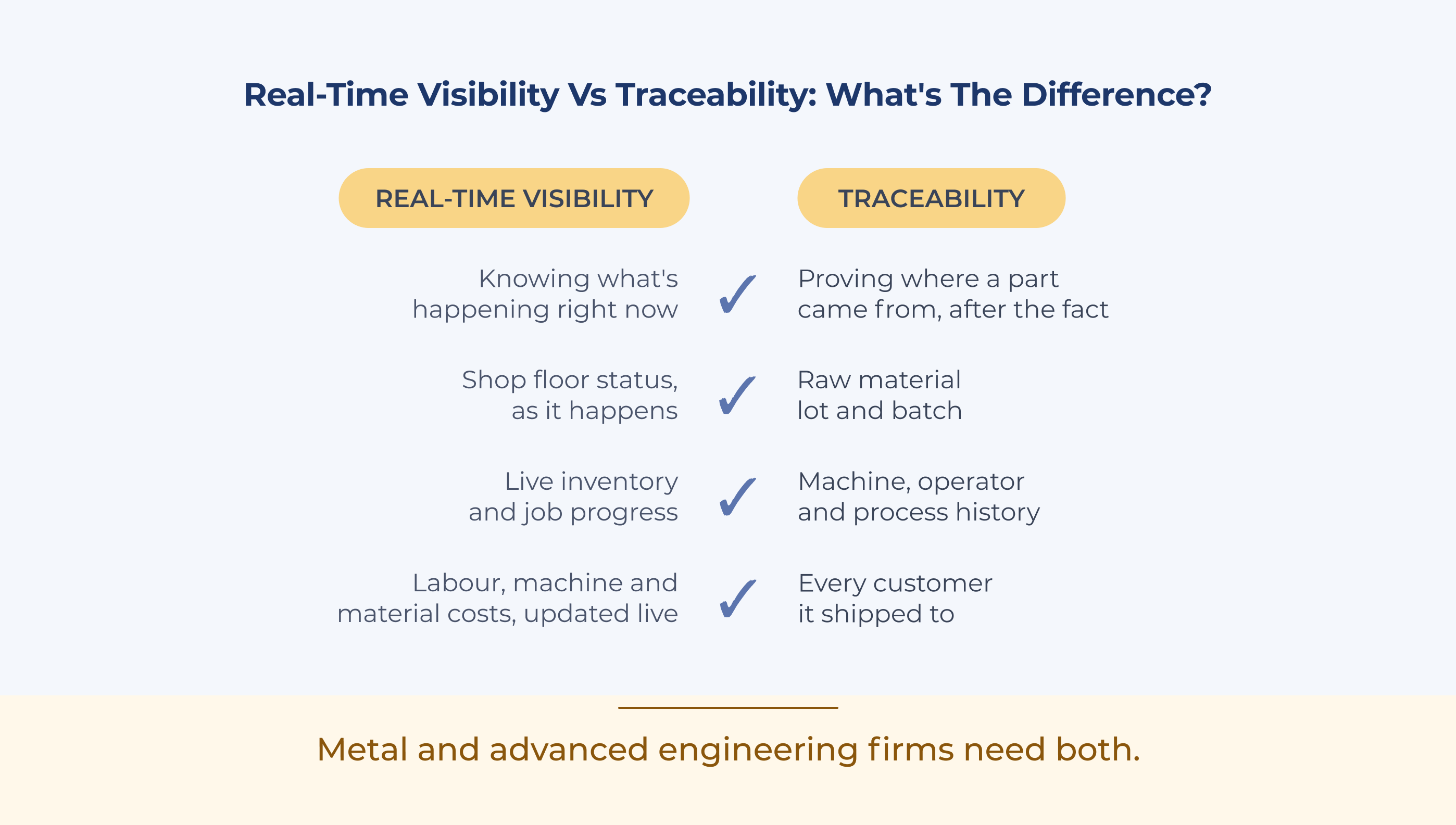
Real-time visibility is knowing what’s happening on your shop floor and in your supply chain right now, not this morning, not at last night’s stock take.
Traceability is being able to answer, after the fact, exactly where a part or batch came from and where it ended up.
A metal fabricator usually feels the visibility problem first: jobs get expedited because nobody spotted a shortage early enough. An advanced engineering business selling into aerospace, defence or automotive supply chains feels the traceability problem first, because standards like AS9100 and IATF 16949 require documented, auditable traceability before a Tier 1 prime will even give you a quote.
Most businesses eventually need both, and most are starting from behind. According to The Manufacturer, 90% of UK manufacturers lack end-to-end supply chain visibility, and only one in ten has full sight of their own supply network.
What it costs when this goes wrong
It depends on how badly, but it’s rarely small. A production run built on a spreadsheet that hasn’t caught up with reality means late deliveries, expedited freight, and awkward conversations with customers. A quality issue that can’t be traced fast enough means a wider recall than it needed to be, and in regulated sectors, it can cost you the contract.
Take Venture Engineering, a precision engineering firm in Witney, Oxfordshire, that machines parts for Formula 1 teams, historic car rebuilds and electric vehicle programmes. For its first decade, the business ran on QuickBooks and spreadsheets: no real-time data, patchy inventory visibility, and project tracking that couldn’t keep pace with a business that had grown into ten times its original footprint.
That’s not a criticism of Venture Engineering. It’s what happens to most fast-growing metal and engineering businesses eventually.
Where an ERP system actually helps
This is where traceability and real-time visibility stop being separate problems and start being the same fix: one system, one source of truth, updated as things actually happen rather than at the end of shift.
In practice, that looks like:
Lot and serial tracking that follows the part, not the paperwork. Capture lot and serial numbers at goods receipt, at every inventory movement, and at every shop floor transaction, so you can trace a finished part back to the exact raw material batch it came from, and forward to every customer it went to.
A live production dashboard, not a printed report from this morning. Work in progress, labour, machine and material costs update as the job moves, not at month end.
Barcode and mobile data capture on the shop floor, so operators record what actually happened without retyping it into a spreadsheet later. That’s usually where the gap between “the system” and “the shop floor” starts.
Material requirements planning (MRP) that spots a shortage while there’s still time to do something about it, instead of when the job’s already late.
Quality management tools for certificates of analysis, non-conformance tracking and corrective action, built into the same system that’s already tracking the part, not bolted on separately.
None of this is exotic. It’s what a properly configured Acumatica Manufacturing Edition does as standard, and it’s a big part of why manufacturers move off spreadsheets and legacy systems in the first place.
Back to Venture Engineering. After moving onto Acumatica Manufacturing Edition, the business now manages more than 20,000 parts with real-time accuracy and fully tracks over 50 projects at once, with real-time visibility into project profitability, labour utilisation and the KPIs that actually decide whether a job made money. Clients get real-time visibility into their own projects too, which the business credits as part of what sets it apart from competitors still working off spreadsheets.
What to ask before you commit
If you’re comparing ERP systems for a metal or advanced engineering business, a few questions cut through the marketing faster than most:
Can I trace a finished part back to the exact raw material lot, without exporting to Excel first?
Does the production dashboard show what’s happening right now, or what happened at the last data upload?
Can the shop floor record data directly, with a barcode scanner or a tablet, without someone retyping it later?
If a customer asked for full traceability tomorrow, how long would that actually take you?
If the honest answer to that last one is “a while”, that’s worth fixing before it’s a customer, an auditor, or a Tier 1 prime asking the question.
Come and talk to us about it
If you’re walking the halls at UK Metal Expo, come and find us at the AcuPower stand C122. We can show you what live traceability actually looks like on a shop floor, not just in a slide deck.
Come and Find Us at Stand C122
Prefer to talk first? Book a conversation with Brendan Mead about where your business actually stands today, not a demo.
Book a Conversation with Brendan
FAQ: traceability and real-time visibility in ERP
What does “traceability” mean in a metal or engineering ERP system?
It means tracking a part or batch through its entire lifecycle: which raw material lot it came from, which machine and operator worked on it, and which customer it was shipped to. Good traceability works both ways, back to source and forward to delivery.
Do I need full traceability if I don’t sell into aerospace or defence?
Not to the same regulatory standard, but most fabricators benefit from it anyway. It’s what lets you isolate a quality issue to one batch instead of a whole production run, and answer a customer query in minutes instead of days.
What’s the difference between lot tracking and serial tracking?
Lot tracking follows a batch of material or parts as a group. Serial tracking follows one individual item. Many metal and engineering businesses need both: lot tracking for raw material, serial tracking for high-value finished components.
How is real-time visibility different from a live inventory count?
An inventory count tells you what’s on the shelf. Real-time visibility tells you what’s on the shelf, what’s committed to a job, what’s on order, and what’s happening on the shop floor, all at once, updated as it happens rather than at the next stock take.
Can one ERP system handle both job shop and repetitive manufacturing traceability?
Yes, provided it’s built for it. Acumatica Manufacturing Edition supports job shop, project-centric and batch-driven production from the same platform, so a business running mixed production types isn’t stitching together separate systems to get full traceability.
Comments (0)
No comments yet
Be the first to comment

 1117
1117